About
@radix-ui/react-dialog is a JavaScript package published to the npm registry. Sourcemap Explorer surfaces it whenever a bundle exposes a matching package.json, node_modules path, or import statement in the original source.
What detecting @radix-ui/react-dialog tells you about a site
@radix-ui/react-dialog reveals an unstyled, accessibility-first primitive — Radix ships the focus-trapping, ARIA-correct behaviour and leaves the styling to you. Finding it (and other @radix-ui/* primitives) is the clearest fingerprint of a shadcn/ui-style design system, where Radix behaviour is paired with Tailwind styling.
Why the exact @radix-ui/react-dialog version matters
Radix primitives are versioned per-package and evolved their controlled/uncontrolled and portal APIs over time; the exact version tells you which behavioural contract the components rely on.
@radix-ui/react-dialog in a real-world stack
When you find @radix-ui/react-dialog in a bundle, it rarely travels alone. Other @radix-ui/react-* primitives, tailwindcss, class-variance-authority and clsx — the canonical shadcn/ui stack.
Quick facts
npm install @radix-ui/react-dialogCommon pairings
Packages this one expects to find in the same project. Each is also a Sourcemap Explorer detection target.
What @radix-ui/react-dialog pulls in
@radix-ui/react-dialog declares 15 direct dependencies — each one also rides into any bundle that ships @radix-ui/react-dialog, so they are detection targets too. Reading them is a quick way to understand the package's real footprint .
How Sourcemap Explorer detects @radix-ui/react-dialog
@radix-ui/react-dialog ships as v1.1.23, published 2026-07-24 and carries 15 direct dependencies, 4 peer dependencies (react, react-dom, @types/react), 405 versions on the registry. Those exact numbers are the footprint Sourcemap Explorer matches when @radix-ui/react-dialog rides inside a deployed bundle — here is how the detection works.
We catch @radix-ui/react-dialog from two complementary signals: bundled source paths and the embedded package.json. Modern bundlers (webpack, Vite, esbuild, Rollup, Turbopack) preserve the original node_modules/@radix-ui/react-dialog/ paths inside the JavaScript sourcemap's sources[] array — that's the canonical signal. When the matching package.json is also captured in sourcesContent[], we read the exact version field — patch number included. No regex guessing, no version inference.
- 1
Confirm the site exposes sourcemaps
In DevTools Network, check the response headers of any application script for `SourceMap` or `X-SourceMap`. Failing that, fetch the script's last 4 KB and look for a `//# sourceMappingURL=` comment — that map is where the `@radix-ui/react-dialog` paths live.
- 2
Find the package in the bundle
Open DevTools → Network → reload. Click any application script and look at its sourcemap. Inside, search `sources[]` for entries matching `node_modules/@radix-ui/react-dialog/` — every match confirms the package is bundled. The matching `sourcesContent[i]` for `node_modules/@radix-ui/react-dialog/package.json` gives you the exact installed version.
- 3
Read the version directly from package.json
Run `jq -r '. as $m | $m.sources | to_entries[] | select(.value | endswith("node_modules/@radix-ui/react-dialog/package.json")) | $m.sourcesContent[.key] | fromjson | .version' bundle.js.map`. Sourcemap Explorer automates the same query in the popup.
Major releases of @radix-ui/react-dialog
When each major version first landed. Major bumps are where breaking changes live, so this timeline is the fastest way to date the @radix-ui/react-dialog version a site actually ships against the ecosystem.
Recent versions
@radix-ui/react-dialog README
Live mirror of the GitHub README, for reference. Updated whenever the repo's default branch changes.
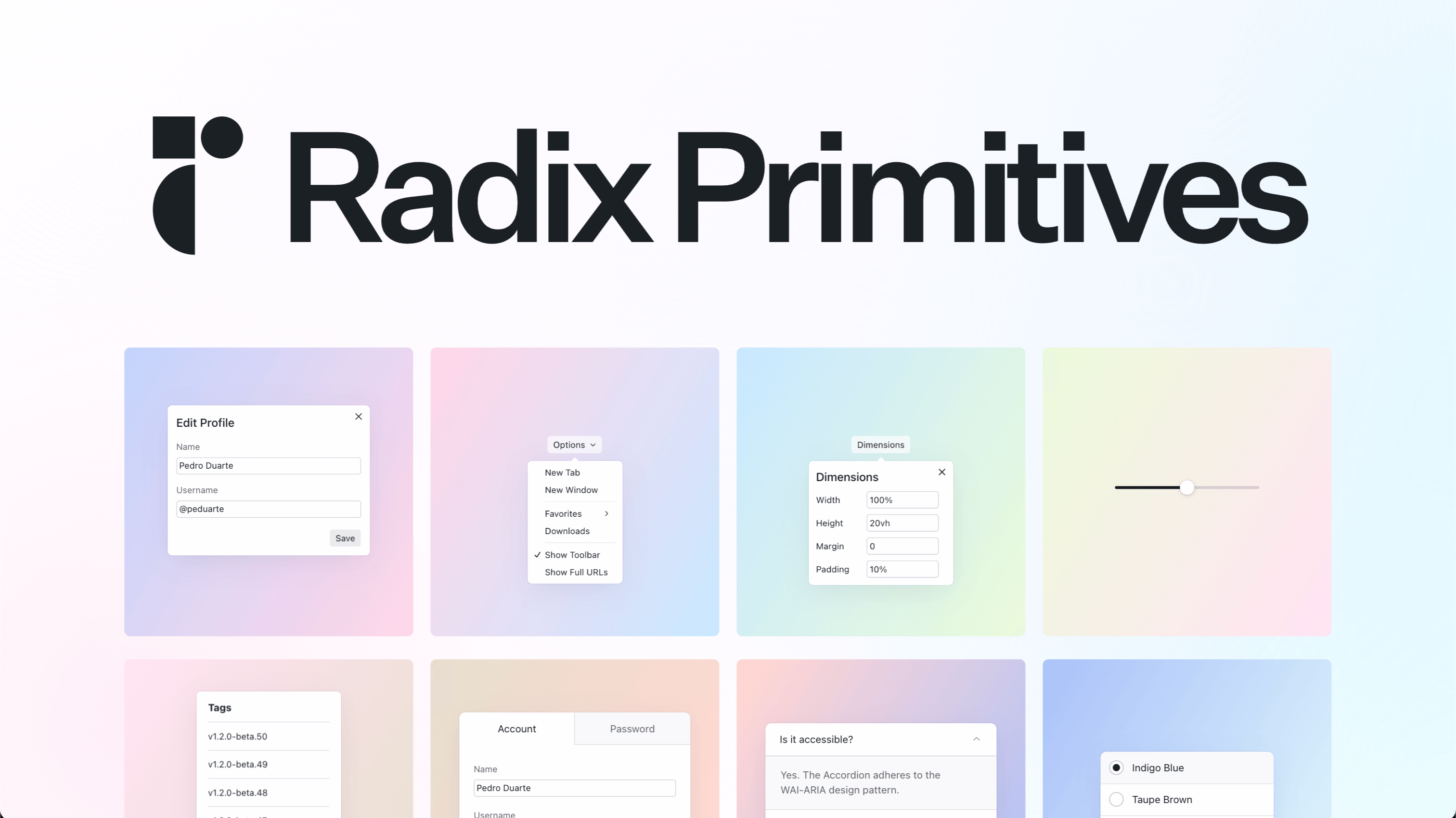
Radix Primitives
An open-source UI component library for building high-quality, accessible design systems and web apps.
Radix Primitives is a low-level UI component library with a focus on accessibility, customization and developer experience. You can use these components either as the base layer of your design system, or adopt them incrementally.
Installation
First, install pnpm if you haven't already. Open your terminal and run:
npm install -g pnpm
Then, install the dependencies:
pnpm install
Documentation
For full documentation, visit radix-ui.com/primitives/docs.
Releases
For changelog, visit radix-ui.com/primitives/docs/overview/releases.
Contributing
Please follow our contributing guidelines.
Community
- Discord - To get involved with the Radix community, ask questions and share tips.
- Twitter - To receive updates, announcements, blog posts, and general Radix tips.
Thanks

Thanks to Chromatic for providing the visual testing platform that helps us review UI changes and catch visual regressions.
License
Licensed under the MIT License, Copyright © 2022-present WorkOS.
FAQ
What is @radix-ui/react-dialog used for?
@radix-ui/react-dialog is a JavaScript package published to the npm registry. The README and import patterns inside published bundles reveal the intended use case; on Sourcemap Explorer it shows up whenever a site bundles `import` from `@radix-ui/react-dialog` or includes `node_modules/@radix-ui/react-dialog/` in a sourcemap.
How can I tell if a website is using @radix-ui/react-dialog?
Open the page in Chrome with the Sourcemap Explorer extension installed and read the Stack tab. We catch `@radix-ui/react-dialog` from two complementary signals: `node_modules/@radix-ui/react-dialog/` paths inside the JavaScript sourcemap, and the embedded `package.json` we read for exact-version detection. Without the extension you can do the same lookup manually in DevTools — the steps are listed in the "How Sourcemap Explorer detects" section above.
How do I find out which version of @radix-ui/react-dialog a website is running?
Read it straight from the site's JavaScript sourcemap. When a build ships source maps, the bundled `@radix-ui/react-dialog/package.json` carries the exact `version` string — Sourcemap Explorer extracts it in one click on the Stack tab, and you can do it by hand in DevTools by opening the `.map` file and searching for `node_modules/@radix-ui/react-dialog/package.json`. That is far more reliable than inferring the version from an asset-hash or a `?ver=` query string, which is all surface-level detectors have to go on. The current npm release is 1.1.23, but real deployments frequently run an older pinned version — which is exactly why reading the bundled number matters.
What is the latest version of @radix-ui/react-dialog?
1.1.23, as published on the npm registry. The "Recent versions" table on this page lists the most recent 8 releases with their release dates. Sourcemap Explorer reports the version actually bundled into a site, which can lag the latest release by months on real-world deployments.
Is @radix-ui/react-dialog actively maintained?
Very actively maintained — the last release shipped within the past three months. The last published release was 2026-07-24. Source code: https://github.com/radix-ui/primitives.
Where can I read more?
Project homepage: https://radix-ui.com/primitives. Source code: https://github.com/radix-ui/primitives. Published on npm: https://www.npmjs.com/package/@radix-ui/react-dialog. Licensed as MIT.
Detected by Sourcemap Explorer
When a bundle ships sourcemaps, we read the embedded package.json for @radix-ui/react-dialog and report the precise version (the registry's latest is v1.1.23, published 2026-07-24; the bundled copy is often older). Without sourcemaps, an import / require in the page's scripts is enough to flag it.